
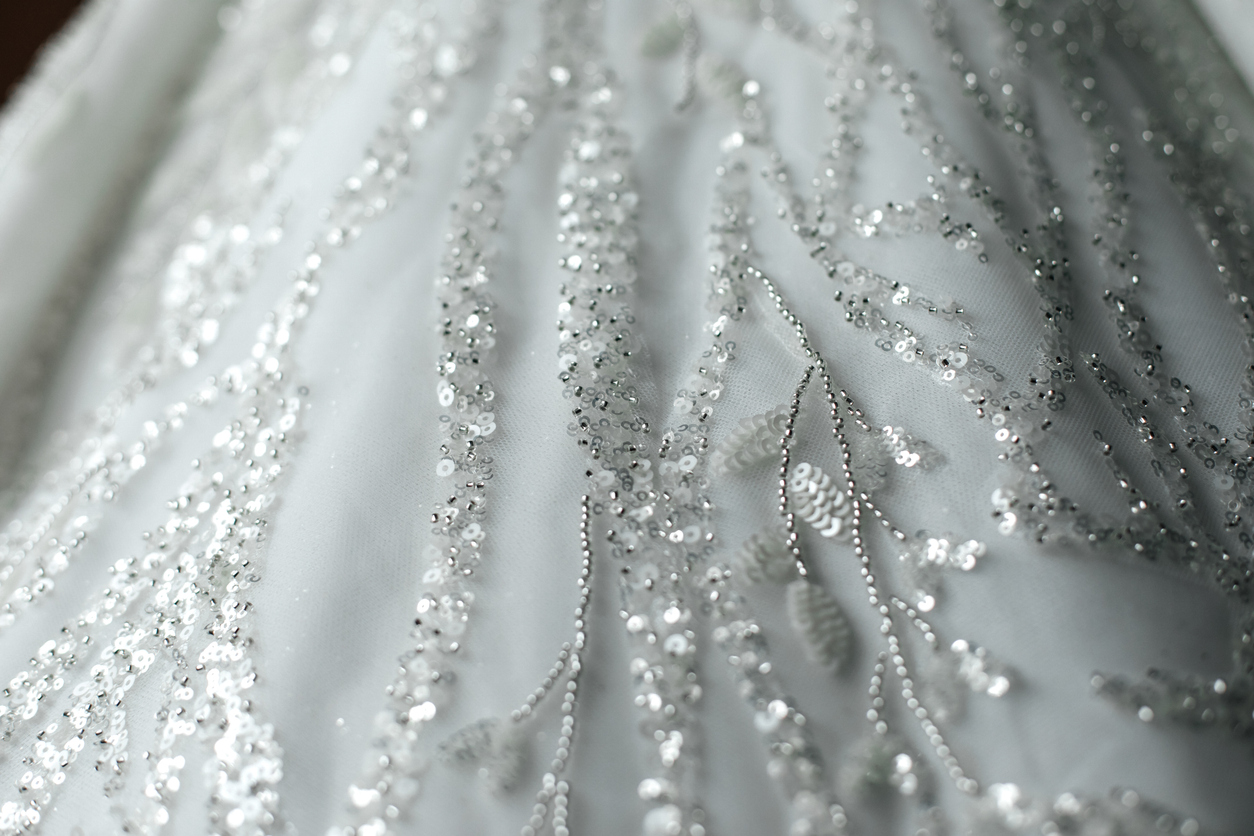
A heavily embellished wedding dress can weigh two, three, or four times what a simple silk dress weighs. That weight doesn’t disappear in storage. It presses down on every seam, every bead cluster, every point of attachment, continuously, for years.
Most preservation boxes and folding methods are designed for average dresses. For a dress with dimensional embellishments, the storage method itself is one of the primary risks.
This guide covers what makes embellished dresses categorically different to preserve and what to verify before trusting any provider with your dress.
Why Embellished Dresses Are Riskier to Preserve Than Plain Wedding Dresses
A plain satin or crepe dress has one primary material to clean and one primary storage challenge. Your embellished dress has layers of distinct materials, each with its own vulnerabilities. When a cleaner doesn’t account for all of them, the damage tends to be permanent.
How Beading, Crystals, and Sequins Respond to Cleaning Solvents
Here is what most standard dry cleaners do not account for with embellished dresses:
- Many beads and crystals are adhered with glue, not stitched by hand. Cleaning solvents can weaken or dissolve that adhesive.
- Glass beads and crystals often have metallic backings. Those backings discolor or corrode when exposed to certain chemicals.
- Most sequins are made from acetate. Standard solvent cleaning can warp them or strip their reflective finish entirely.
A cleaner using a standard dry cleaning cycle on your dress hasn’t thought through any of this. The damage won’t be obvious when you pick up the dress. It shows up six months later, or six years later.
What Can Go Wrong With Lace and Embroidery During Preservation
Lace is made from fine cotton or silk thread in an open mesh structure. It has almost no tolerance for error, therefore:
- Improper cleaning breaks individual fibers and distorts the pattern shape.
- Ivory and champagne lace is especially prone to color shifts, even from mild chemical exposure.
- Embroidery stitching puckers or loosens if the base fabric shifts unevenly during cleaning.
None of these outcomes are reversible. That is why the process has to be right the first time.
How a Professional Dress Preservation Process Actually Works
If you have been comparing quotes without a clear picture of what the process actually involves, this is what you should expect from a specialist.
Pretreatment Inspection: Mapping Every Embellishment Before Cleaning Begins
Before anything touches a cleaning solution, a specialist examines the entire dress and documents what they find.
- Every bead cluster, crystal section, lace panel, and embroidered detail is noted.
- Adhesive integrity is checked. Loose or already-failing stones are flagged.
- Any pre-existing damage is communicated to you before the process begins, not discovered after.
This pre-cleaning map is the difference between a provider who is accountable and one who isn’t. If a cleaner skips this step, you have no baseline if something goes wrong.
Cleaning Methods Suited to Mixed-Material Dresses
Heavily embellished dresses are not dry cleaned through a standard solvent cycle. A specialist uses hand cleaning or a controlled wet cleaning process, selected specifically because it removes stains without exposing adhesives, metallic backings, or delicate base fabrics to conditions they cannot tolerate.
The distinction matters: standard dry cleaning is effective for many garments. For a dress with adhesive set crystals layered over silk, it is the wrong tool. A provider who cannot describe how they will adjust their method for your specific embellishments will likely not adjust it at all.
Drying and Finishing: Why Rush Drying Is a Risk Specific to Embellished Dresses
This step is where high-volume cleaners cut corners, and where embellished dresses suffer the most invisible damage.
- Heat drying warps acetate sequins.
- Forced air weakens adhesive set crystals.
- Rapid drying causes silk lace to shrink or pucker.
- Embellished dresses must air dry flat or on a padded form, away from direct heat, at whatever pace the materials require.
Acid-Free Preservation Packaging for Dresses With Beading and Lace
Cleaning is only the first half of how to preserve a wedding dress properly. The second half is how the dress is packaged, and this is where most standard preservation services fall short with embellished dresses.
Why Standard Preservation Boxes Do Not Work for Embellished Dresses
When a beaded dress is folded flat and placed in a standard museum-quality box, the beads press against the fabric at every fold point. Over years, the weight of the layers above creates:
- Permanent fabric indentations at every fold
- Cracked or loosened beads where pressure concentrated
- Crystal loss in areas that were unsupported
A specialist adds acid-free tissue padding between every layer, with bead heavy sections actively supported rather than left to compress. The box matters. How the dress is packed inside the box matters more.
How Lace Panels Are Protected From Creasing and Fiber Stress in Long-Term Storage
Lace cannot be folded against itself or against other fabric without a tissue buffer between them. For larger lace sections, a specialist will loosely roll the panels around a tissue covered tube rather than fold them at all. This is not extra service or an upsell. It is the correct standard to preserve the lace you want to look intact in 20 years.
Zero sustained pressure on any lace panel. That is the goal.
Save the Beauty of Your Embellished Wedding Dress with Pristine Fine Dry Cleaning
You want every bead, sequin, and delicate embellishment to look just as beautiful years from now as it does today. Schedule your FREE consultation with Pristine Fine Dry Cleaning and let our specialists create a preservation plan tailored to the unique fabrics, details, and hidden stains of your dress.
With more than 42 years of experience and complimentary Pickup and Delivery Service throughout Lely and Naples, protecting your most cherished wedding keepsake has never been easier.
📍 506 9th Street N, Naples, Florida, 34102
📞 +1 239-429-0137
📍 4596 Tamiami Trail N, Naples, Florida, 34103
📞 +1 239-237-3029
📧 info@pristinefinedrycleaning.com
Questions to Ask Before Trusting Any Cleaner With an Embellished Dress
You already did the research. These three questions will tell you quickly whether or not a provider has real experience with embellished dresses or if they are applying a one-size-fits-all approach to a dress that cannot absorb that mistake.
1. Do You Inspect Embellishments Individually Before Cleaning?
A confident yes is the starting point. What you listen for after that: can they describe what they are actually checking for? A provider who mentions adhesive integrity, fragile lace attachment, or pre-existing stone loss has done this before. A vague answer, or a pivot straight to price, is a signal to keep looking.
2. What Cleaning Method Do You Use for Beaded or Crystal-Embellished Fabric?
The answer should include an acknowledgment that adhesive set embellishments require a modified process. If the answer is a standard dry cleaning cycle with no further detail, that provider will not treat your dress differently than a plain dress. That is the gap you are trying to close.
3. How Is the Dress Packaged to Prevent Bead and Lace Damage During Storage?
Listen for: tissue padding between layers, support for bead-heavy sections, and specific handling for lace panels. A provider who describes only a museum-quality box without any mention of embellishment-specific packing likely does not have experience with this dress type.
These are not trick questions. They are reasonable, direct questions about a specialized service. A provider who cannot answer them in specific terms is not the right fit for your dress.