
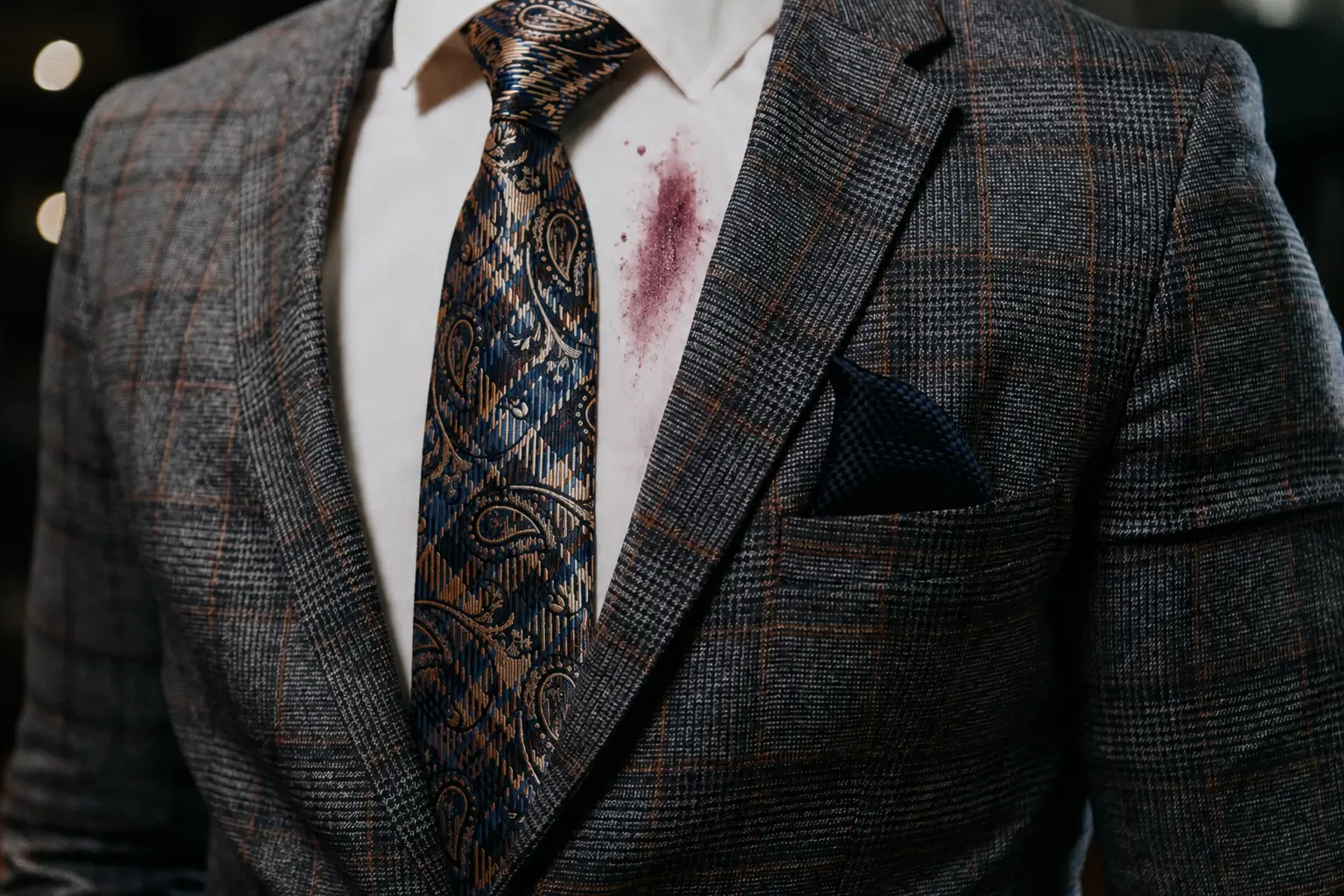
Somewhere in the room right now, a glass just tipped, and a clock started that most people don’t know exists. You have about sixty seconds before the choices narrow considerably, and what you reach for in that window matters more than anything a professional does afterward. Most formal suits can survive this completely.
A handful of wrong instincts – water, salt, a napkin dipped in soda water – are what actually turn a recoverable spill into permanent damage. Here’s exactly what to do in that window, and why your suit needs it more than any other garment you own.
The First 60 Seconds That Determine the Outcome
The moment wine hits your jacket, you’re working against a short window. Do these things, in this order:
- Blot immediately: with a clean, dry cloth or napkin. Press straight down, then lift. Don’t drag or wipe.
- Leave the water alone: skip the sink, the soda water, and the damp napkin from the bar.
- Skip the salt: it’s the most repeated wine stain advice out there, and it does almost nothing for a suit.
- Get the jacket off your body: and onto a flat surface or hanger as soon as you can.
If this happens mid event, you don’t need to make a scene. Excuse yourself, find a quiet spot, and blot the stain with whatever clean, dry fabric you can grab: a cloth napkin, a handkerchief, even a folded paper towel in a pinch.
Once you blot what you can, take off the jacket and drape it over a chair back instead of folding it or stuffing it into a coat check bag pressed against other garments. Pressure and body heat both work against you here.
Blot, Don’t Rub, and Why the Rest of the Popular Advice Fails on Tailored Suits
Rubbing feels productive. It isn’t. When you work a cloth back and forth across the stain, you drive the wine deeper into the weave, and on many formal fabrics, you scuff the surface finish that gives your suit its sheen or texture in the first place. Once that finish is scuffed, no amount of cleaning brings it back.
Blotting, by contrast, lifts the liquid off the surface before it travels further into the fibers. That’s the entire mechanism, and it’s also why most generic stain removal advice you’ll find online doesn’t hold up on a suit. Those articles are written for cotton shirts and tablecloths, garments built from a single layer of washable fabric.
Your suit isn’t built that way, and treating it like it is tends to be where the real damage starts.
Why a Formal Suit Is a Different Kind of Stained Garment
Red wine stains for two chemical reasons: anthocyanins, the pigments that give the wine its color, and tannins, which bind that pigment to fibers and make it harder to lift the longer it sits. That chemistry doesn’t change whether the wine lands on a cotton napkin or your tuxedo jacket. What changes is what’s underneath your fabric.
A suit combines several carefully constructed layers to create its structure. Treating it like an ordinary garment can do more harm than the stain itself.
The Interior Construction Home Treatment Ruins Before the Outer Fabric
A formal jacket may contain:
- Interfacing that gives the chest and lapels their structure
- A canvas chest piece that supports the lapel roll in higher quality suits
- Shoulder padding that maintains a balanced silhouette
- A separate lining made from silk, cupro, or a Bemberg blend
Each layer reacts differently to water and heat. Since you can’t see these components from the outside, you may not notice the damage until the jacket dries.
How Home Treatment Can Damage the Suit
- Too much moisture can distort its structure: even pressing a damp cloth too firmly or leaving it in place too long can soak the interfacing. As it dries, the material may shrink unevenly and alter the shoulder line or lapel roll.
- A wet canvas chest piece may warp: if the canvas becomes soaked and air dries without professional reshaping, it can stiffen or change how the jacket sits on your body.
- The lining may shrink at a different rate: because the lining and outer shell use different fibers, moisture can pull them out of alignment and affect the jacket’s overall fit.
- Heat can set the stain permanently: heat bonds the wine pigments more tightly to the fibers, and at the same time may warp the hidden structural components of the jacket.
Avoid using a hair dryer, iron, or direct sunlight. These methods may make the stain permanent while damaging the shape of the suit. For a formal suit, specialist care isn’t simply a preference. It protects both the fabric you can see and the carefully constructed layers underneath it.
How the Outer Fabric Affects the Response
The construction underneath is your bigger risk, but your outer fabric still shapes what treatment looks like once your suit is in professional hands. Some formal fabrics tolerate a broader range of solvents and pressure. Others need a far more conservative touch, and knowing the difference before any work begins is part of what separates a real assessment from guesswork.
Wool Suiting, Silk Blend Tuxedo Lapels, Velvet Dinner Jackets, and Structured Blends
Wool Suiting: The Most Forgiving
Wool generally responds well to professional stain treatment because it:
- Handles dry cleaning solvents well
- Tolerates careful spotting techniques
- Has a good chance of recovery when treated promptly
Still, the stain’s age and any previous home treatment can affect the final result.
Silk Blend Tuxedo Lapels: Watch for Watermarks
Most tuxedo lapels use silk blend faille or grosgrain. These fabrics mark more easily than plain wool, and even moisture from blotting can leave a visible ring. Blot as little as possible and let your cleaner use a conservative treatment designed for the lapel fabric.
Velvet Dinner Jackets: Follow the Nap
Velvet requires special care because its raised pile can flatten or crush under pressure. If you need to blot the spill:
- Follow the direction of the nap
- Use very light pressure
- Never rub or move against the pile
Once crushed, the texture may be difficult to restore, even with professional steaming.
Mohair Blends and Structured Cottons: Proceed Carefully
Mohair blends and structured cottons often appear in formal blazers and lightweight dinner jackets. They usually tolerate professional treatment reasonably well, but their looser weave or textured finish calls for a more conservative approach than standard wool. Identifying the outer fabric before treatment helps your cleaner choose the safest combination of solvent, pressure, and stain removal technique.
The Home Remedies That Don’t Work
You’ve probably already heard of both of these. Skip them anyway.
- Salt: it’s supposed to draw out the wine, but it doesn’t touch pigment that’s already bonded to your fibers. Best case, it does nothing. Worst case, it leaves behind its own residue.
- Club soda: this one’s mostly folklore. The carbonation doesn’t lift wine pigment any better than plain water, and plain water is already off the table on your tailored construction.
The Home Remedies That Actively Damage Formal Construction
These go a step further than doing nothing. Use any of them, and you work against your own suit:
- Hot water: heat sets the wine’s pigment into your fibers and risks shrinking your lining.
- Hydrogen peroxide: it bleaches unpredictably on dyed formal fabrics, and you rarely get an even result.
- Any bleach product: expect this to damage or destroy the fabric on nearly any formal suit.
- A hair dryer or iron used to speed up drying: heat sets the stain permanently and can warp your interior construction at the same time.
What to Do If the Wine Has Already Dried
Maybe you’re only finding this a day later, discovering a stain on a suit already back on its hanger. Your odds are lower than they would be for a fresh spill, but you can often still recover the suit. Speed matters most at this stage: the sooner you get the suit to a professional, the better your chances.
Don’t attempt to treat a dried stain yourself, even with a product marketed as gentle. Dried wine has had time to bond more deeply with the fibers, so amateur intervention is more likely to set it further than lift it. Bag the jacket loosely, keep it out of direct sun and heat, and get it in for an assessment as soon as you can.
What Professional Cleaning Actually Does for Wine Stains on Formal Suits
Professional dry cleaning starts with an assessment of your specific fabric, not a one-size-fits-all treatment run on every garment that comes through the door. They calibrate pretreatment to whether you’re wearing wool, a silk blend lapel, velvet, or a structured blend, and they choose a cleaning method that works with the interior construction of your suit rather than against it.
That means keeping water away from the interfacing and canvas, holding off on heat until the stain is fully addressed, and giving you an honest read on what your suit needs and a result that is realistic.
A good cleaner tells you before the work begins whether a stain is likely to lift completely, partially, or not at all, instead of promising a result they can’t guarantee.
Restore Your Suit’s Best Look with Professional Care from Pristine Fine Dry Cleaning
If you’re dealing with a red wine spill on a formal suit, don’t leave the outcome to chance. Pristine Fine Dry Cleaning is the dry cleaning Naples customers trust for formalwear emergencies, with pretreatment tailored to the fabric of your suit, cleaning methods that protect its construction, and an honest assessment before any work begins.
Bring in your suit the same day whenever possible, or call ahead so our team can prepare for a rush assessment before you arrive.
Downtown Naples
📍 506 9th Street N, Naples, Florida, 34102
📞 +1 239-429-0137
North Naples
📍 4596 Tamiami Trail N, Naples, Florida, 34103
📞 +1 239-237-3029