
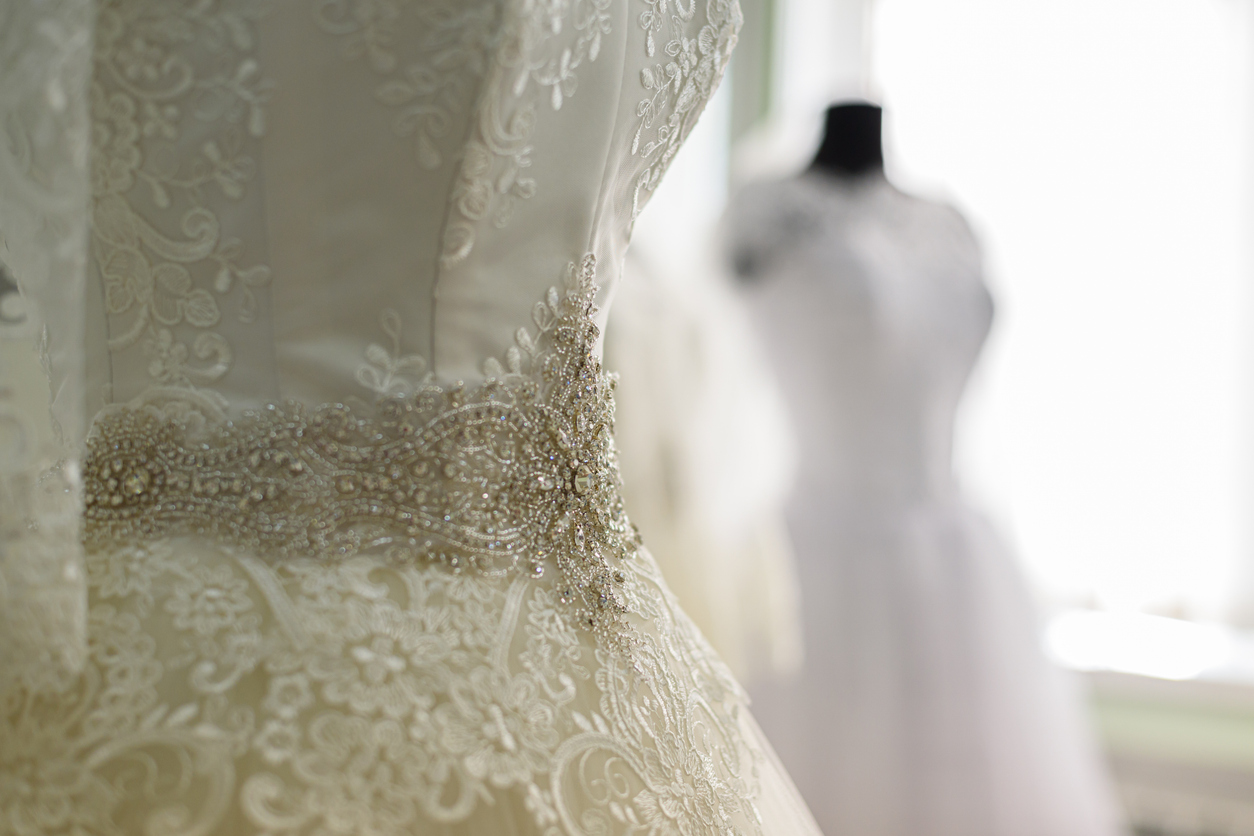
When a skilled tailor looks at your wedding dress for the first time, they don’t see what you see. They see seam allowances and structure points. They see where the fabric needs to be released and where it needs to be taken in. They see the finished version of a dress that, to everyone else in the room, looks like it still has a long way to go.
That translation, from almost to exactly, is what the alteration process is built to deliver. This guide shows you every step of how it happens.
Stage 1: The First Fitting – What Gets Pinned and Why
What the Tailor Looks For
In the first fitting, your tailor is not trying to make the dress look finished yet. They study how the dress behaves on your specific body, where the fabric pulls, where it gaps, how the hem breaks over your shoes, and whether the bust sits too high or too low.
Every pin they place is a note: this needs to come in here, this needs to be let out there. A skilled tailor moves slowly at this stage because one adjustment affects everything around it.
Taking in a side seam, for example, changes how the zipper sits and how the skirt falls. That interconnected thinking is what separates a great bridal tailor from someone who can just sew a straight seam.
Take Your Wedding Shoes – This Is Non-Negotiable
Take your exact wedding shoes to this appointment and your wedding undergarments, too.
Hem length is set entirely by heel height. Show up in sneakers planning to wear a three-inch heel on your wedding day, and your tailor cannot set the correct hem length. You’ll end up with a dress that either drags or sits too short on the dance floor.
The undergarments and shapewear you’ll wear under the dress affect how the bodice sits and where straps fall. What you wear to the fitting should match what you wear to the wedding.
Alterations Almost Every Dress Needs
If your tailor mentions a long list of adjustments at the first fitting, that is completely normal. Most wedding dresses, regardless of size or silhouette, need some version of the following:
- Hem shortening: off-the-rack dresses are cut long to fit the widest range of heights. Almost every bride needs hers shortened.
- Side seam or bust adjustment: standard sizing doesn’t account for how bodies are actually proportioned. Taking in or letting out is routine.
- Strap adjustment: spaghetti straps, illusion necklines, and lace overlays almost always need repositioning or shortening.
- Bustle attachment: any dress with a train needs a bustle built in so you can move freely at the reception. This is added during alterations, not included with the dress.
Needing all of these doesn’t mean the dress is wrong for you. It means the alteration process is working exactly as designed.
Stage 2: The Work Between Fittings – What the Tailor Is Actually Doing
Structural vs. Cosmetic Alterations: Why Some Changes Take Longer
A cosmetic alteration is relatively contained – shortening a strap, hemming a plain satin skirt, or taking in a side seam on a smooth fabric. These move fast and are more predictable.
Structural alterations are another story. Moving a sweetheart neckline means rebuilding the boning and inner support underneath it. Reducing a corseted back changes the geometry of the entire bodice. Changes like these require multiple rounds of work and multiple fitting checks.
Lace, Beading, and Embellished Fabrics: Why These Take Longer
If your dress has lace, beading, or embroidery, build in extra time and budget from the start. When a seam is moved on a lace dress, the lace pattern has to match at the new seam line. Mismatched lace is visible and fixing it requires careful hand stitching.
When beading runs across a seam that needs to be taken in, each bead along that line has to be removed, the seam adjusted, and the beading reattached by hand. On a heavily beaded dress, that is hours of work.
Naples has a strong market for high-end, embellished bridal dresses. If that describes your dress, work with a tailor who has specific experience with those fabrics and give yourself at least four to five months before the wedding.
Stage 3: The Second and Third Fittings – What’s Being Checked Each Time
Why Multiple Fittings Are Standard, Not a Sign of Problems
After your tailor completes the first round of work, you come back for the second fitting, a progress check. The dress goes on, and your tailor evaluates whether the first round of adjustments achieved what was intended. Did taking in the side seam create the right silhouette, or does the bodice now feel slightly tight across the upper back? Did the hem land correctly?
Bodies shift. Posture varies from day to day. Fabric behaves differently after it has been altered, i.e., satin and silk can relax or tighten in ways that need minor correction. Two or three fittings isn’t a red flag. It means your tailor is paying close enough attention to catch small things before they become final.
How the Final Fitting Is Different
The last fitting has a completely different feel from everything before it. Nothing gets assessed from scratch. The work is done, and this appointment is about confirming it.
You put on the complete look: the dress, your wedding shoes, your undergarments, your veil or headpiece, your jewelry. You sit down, walk across the room, do a full turn. Your tailor does a final scan, a small tack here, a snap repositioned there.
The goal is that you leave this appointment with absolute certainty that the dress fits. That confidence going into your wedding day is exactly what the entire process builds toward.
How Far in Advance to Start Wedding Dress Alterations
Alteration Timelines for Different Wedding Dress Styles
Simple Dress
Start Alterations: 3–4 months before the wedding
Final Fitting: 4–6 weeks before the wedding
Ideal for dresses with minimal adjustments and straightforward construction.
Lace, Beaded, or Heavily Embellished Dress
Start Alterations: 4–5 months before the wedding
Final Fitting: 4–6 weeks before the wedding
Extra detailing often requires more time and precision during alterations.
Dress Requiring Major Structural Changes
Start Alterations: 5+ months before the wedding
Final Fitting: 4–6 weeks before the wedding
Significant modifications, such as reshaping the bodice or changing the silhouette, should begin as early as possible.
Keep the final fitting no more than four to six weeks before the wedding. Earlier than that and you risk small fit changes. Later than that and there’s no safety net if a minor adjustment is needed.
What If You’re Starting Later Than Recommended?
It depends on the wedding dress. A plain crepe or satin dress needing a hem and a side seam adjustment can often be turned around in four to six weeks without compromising quality. A rushed alteration on an embellished dress is a different situation entirely. Lace matching under time pressure is exactly where mistakes get made that cannot be undone before the wedding.
The later you start, the fewer options you have. Demand for bridal alterations in Naples typically peaks in spring and early fall when wedding dates cluster. If your date falls in those windows, booking early isn’t just smart – it is often the difference between getting the tailor you want and settling for whoever has an opening.
Let Pristine Fine Dry Cleaning Perfect Every Detail of Your Wedding Dress
Careful bridal alterations can turn even the most beautiful dress into a flawless fit that photographs beautifully and feels incredible to wear throughout every moment of your wedding day.
At Pristine Fine Dry Cleaning, our experienced tailors and wedding dress specialists provide expert alterations, precise fittings, delicate repairs, and customized dress care designed to enhance your comfort, confidence, and overall bridal look while preserving every intricate detail of your dress.
From bustle adjustments and seam refinements to stain removal and full dress transformations, Pristine Fine Dry Cleaning is here to help. Schedule your FREE consultation today and experience precision bridal tailoring work.
Pristine Fine Dry Cleaning – Downtown Naples
📍 506 9th Street N, Naples, Florida, 34102
📞 +1 239-429-0137
Pristine Fine Dry Cleaning – North Naples
📍 4596 Tamiami Trail N, Naples, Florida, 34103
📞 +1 239-237-3029